

Tools like firewalls and intelligence feeds fuel modern cybersecurity. This is good, but security operations centers (SOCs) can face an overwhelming volume of daily alerts generated by these sources. Managing them manually can lead to operational fatigue and delayed responses.
To overcome alert fatigue and its challenges, many organizations have turned to Security Orchestration, Automation, and Response (SOAR). While the automation portion handles repetitive tasks, the security orchestration aspect acts as the connective tissue that brings together disparate security systems into a single cohesive defensive environment.
Security Orchestration Defined
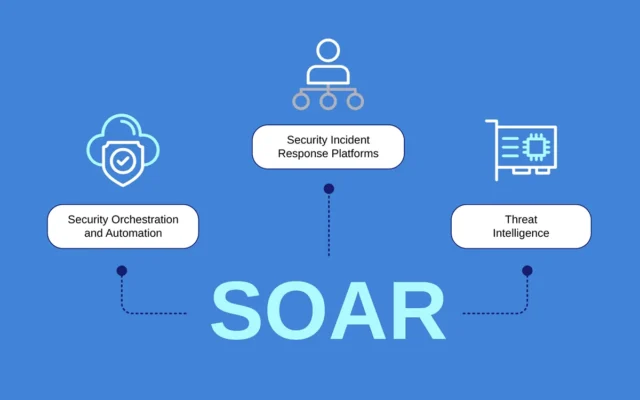
The automation tools within a SOAR platform automatically execute individual programmatic actions for tasks like blocking an IP address. Security orchestration is different. It focuses on integration and workflow management across an organization’s entire security stack.
DarkOwl, a leader in SOAR integration, explains that security orchestration connects disparate security tools. It brings together threat intelligence platforms, EDRs, SIEMs, and even ticketing systems to create a standardized execution pathway known as a playbook. Theoretically, an organization builds as many playbooks as it needs to maintain proper cyber defenses.
Why Security Orchestration Matters
Security orchestration matters because without it, disparate tools and systems are incapable of working together for maximum advantage. Tools and systems operate in silos, limiting their ability to improve an organization’s security posture. On the other hand, security orchestration accomplishes some very important things:
- Silo Elimination – Orchestration makes it possible for disparate tools to exchange data seamlessly with no need for human intervention. Silos all but disappear.
- Response Standardization – Orchestration ensures that security analysts follow repeatable and pre-approved processes during every incident. Human errors are reduced.
- Response Acceleration – Orchestration reduces Mean Time to Respond (MTTR) by automatically coordinating actions across multiple systems. Incident response times drop from hours to seconds.
Within the context of SOAR integration, orchestration is very similar to a musical orchestra’s conductor. It brings all the players and instruments together, on the same page, so they produce cohesive music instead of a cacophony of noise.
Integrating SOAR With Existing Defenses Is Critical
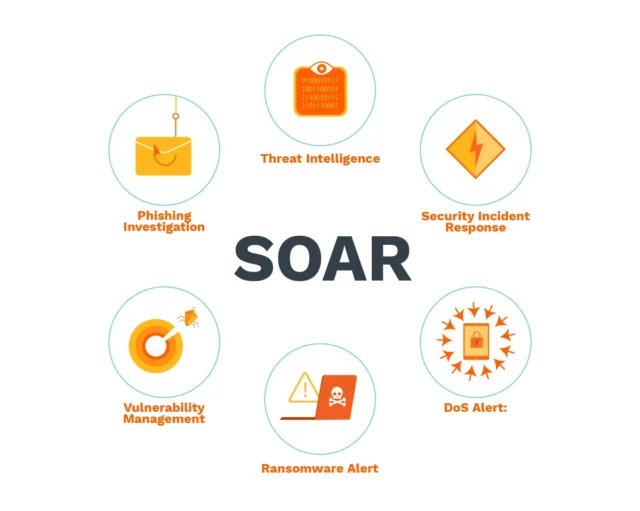
Implementing SOAR integration allows security teams to optimize their existing technology investments. There is less need to replace what already exists because disparate tools work more effectively together. SOAR integration yields very tangible results.
For starters, integration connects external intelligence sources with a SOAR platform. This allows enterprise security tools to ingest massive amounts of high-value threat data automatically. When dark web intelligence identifies a potential threat, the platform can immediately trigger a defensive playbook.
SOAR integration also streamlines analyst workflows. In so doing, it reduces mental fatigue and human error. A good SOAR platform aggregates incident context within a central interface, allowing analysts to approve automated mitigation steps with a single click.
The icing on the cake is the ability for SOAR integration to scale with security operations. Unlike manual security procedures, which often cannot keep pace with growth, orchestrating security workflows within a SOAR environment scales things effortlessly. SOC teams can continue to process higher alert volumes without the need to hire more people.
Building Effective Security Orchestration Playbooks
Successful security orchestration depends on how well organizations structure their response playbooks. Each playbook should address a specific incident type and establish clear steps for investigation, escalation, and remediation. Many teams benchmark their own procedures against standardized references like CISA’s Cybersecurity Incident and Vulnerability Response Playbooks, which lay out a repeatable structure for identifying, coordinating, and remediating threats.
Consider a phishing incident. A playbook can automatically retrieve suspicious email headers, analyze embedded links, compare findings against threat intelligence databases, and identify other employees who received similar messages. Security analysts receive the collected evidence without manually switching between multiple platforms.
Organizations should prioritize frequently occurring incidents when developing their first playbooks. Starting with established procedures allows teams to evaluate performance, identify weaknesses, and refine automated workflows before expanding orchestration into more complex security scenarios.
The Importance of Reliable Security Integrations
Connecting security products doesn’t automatically guarantee that information flows correctly between them. Different systems may use incompatible data formats, authentication methods, or application programming interfaces (APIs). Poorly configured integrations can introduce delays and undermine the benefits of orchestration.
Security teams should therefore test integrations under realistic operating conditions. An endpoint that becomes unavailable, an expired authentication token, or an interrupted API connection shouldn’t cause an entire incident response workflow to fail without notification.
Maintaining detailed execution logs also helps analysts identify unsuccessful actions and investigate unexpected outcomes. Regular integration reviews become particularly important when organizations update existing security products or introduce new tools into their infrastructure.
Balancing Automated Responses With Human Oversight
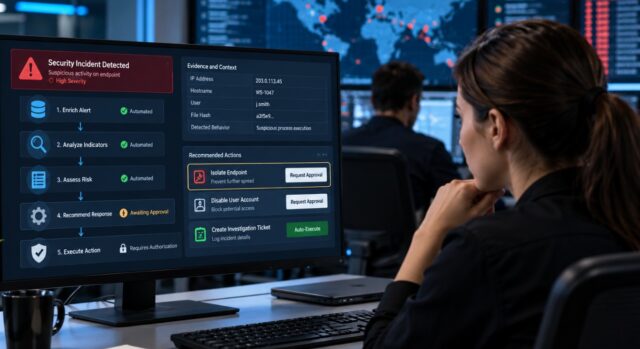
Not every security incident should trigger an entirely automated response. Certain actions, including isolating critical servers or disabling employee accounts, can interrupt business operations when executed incorrectly.
Security orchestration allows organizations to establish approval requirements for potentially disruptive actions. A playbook can gather evidence, assess indicators of compromise, and recommend a response while leaving the final authorization to an experienced analyst.
Lower-risk activities, such as enriching alerts and creating investigation tickets, can proceed without approval. Higher-impact decisions receive additional scrutiny. Establishing these boundaries helps organizations benefit from faster security operations without sacrificing accountability or introducing unnecessary operational risks.
Measuring the Impact on SOC Performance
Organizations need measurable evidence that their orchestration investments are improving security operations. Tracking performance before and after implementation provides a clearer picture than simply counting how many automated workflows have been deployed.
Mean Time to Detect (MTTD) and Mean Time to Respond (MTTR) are useful starting points, and frameworks such as NIST’s incident response guidance under CSF 2.0 offer a structured way to define and track them consistently. Security teams can also measure alert investigation times, false-positive rates, and the number of incidents requiring manual intervention.
However, faster responses shouldn’t come at the expense of investigation accuracy. Reviewing unsuccessful playbook executions and analyst feedback helps identify areas requiring improvement. Regular performance assessments allow SOC managers to adjust workflows as threats evolve and operational requirements change.
Security Orchestration Changes the Defensive Posture
SOAR platform integration relies on security orchestration to bring together fragmented operations. Orchestration creates an agile, intelligence-led defense that performs so much better than traditional siloed operations.
When all is said and done, security orchestration actually changes an organization’s defensive posture. Rather than constantly scrambling to make sense of things when incidents occur, orchestration invites security teams to be more proactive, less likely to chase noise, and better prepared to respond quickly when something happens.
And that is why optimizing SOC efficiency with security orchestration matters.