Home Blog

Luxury Spa Retreats in Bavaria and the Alps Worth the Splurge

Luxury alpine hotel nestled among snow-covered mountains and a dense winter forest.

A luxury spa break in Bavaria can mean very different things: swimming outdoors beneath snowy peaks, retreating to a quiet meadow, or alternating a Japanese-style hot bath with a cold plunge beside an alpine lake. The best choice is not necessarily the resort with the most pools. It is the one whose setting, pace and spa rituals suit the trip you actually want.

Green peaks of the Bavarian Alps near Kempten, Germany, setting the scene for a mountain spa escape.

These three retreats make a strong case for spending more than you would on a standard hotel weekend, but for different reasons. One is a destination in its own right; one is built around stillness; and one works particularly well if you want to test the spa as a day guest before committing to an overnight stay.

Choose the kind of luxury you want

At the top end, “spa hotel” can describe anything from a good pool and a treatment menu to a resort with several separate wellness worlds. I would pay a premium for a place that gives the day a satisfying rhythm: a swim, time outside, a treatment or sauna, then somewhere genuinely calm to eat and rest. A long facilities list matters less if you will spend most of the stay away from the hotel.

One practical detail worth checking before booking is who can use which areas. Some spas divide facilities by age or make certain pools and saunas adults-only. And treatments often need to be reserved in advance; the ideal time slot is not guaranteed just because the room is booked.

Schloss Elmau: the full destination-resort splurge

Schloss Elmau, in a secluded valley near Garmisch-Partenkirchen, is the pick for travelers who want the resort itself to be the itinerary. Its six spa areas combine adults-only and family-friendly spaces, with pools, saunas, a hammam, yoga and treatment facilities. That variety is unusually useful for a mixed-age group: one person can seek out a quiet adult pool while another uses a family spa, then everyone can meet for dinner.

The signature experience is less “one spectacular infinity pool” than a succession of moods. The adults-only Badehaus includes several outdoor pools; at the Retreat, the Shantigiri Spa pairs a 20-metre infinity pool with a 40°C Japanese onsen. There is also a Nature Spa beside the Ferchenbach stream, where a rustic sauna and cold-water dip feel deliberately different from the polished bathhouse. The Schloss Elmau spa overview lays out the distinctions between its facilities.

Outdoor resort pool framed by a snowy forest, evoking a winter spa retreat in the Alps.

Worth the splurge if: you will spend several days on site and want wellness, dining, culture and mountain scenery under one roof. It is less compelling as a quick overnight stop, when travel time and the sheer number of options can crowd out the actual rest you came for.

Das Kranzbach: quiet is the main amenity

For a slower, more secluded stay, Das Kranzbach sits on a protected mountain meadow below the Zugspitze. The hotel describes a spa with five pools and nine saunas or steam baths, reached via a light-filled wooden-and-glass bridge. That transition says something about the place: the spa is not simply an add-on to the guest room, but a separate world where you can let the day unfold without much planning.

The property is adults-only, and its official wellness information lists a separate ladies’ sauna and relaxation area. This makes it a strong choice for couples or solo travelers who prize quiet over a resort’s entertainment schedule. The trade-off is the same feature that makes it special: it is a hideaway, not a convenient base for ticking off a long list of nearby attractions. Book massages and other treatments ahead; the hotel explicitly recommends arranging preferred appointments before arrival. See Das Kranzbach’s current spa facilities and hours before planning your day.

Modern wood-paneled sauna with a premium heater, suited to an upscale alpine wellness retreat.

Worth the splurge if: your idea of luxury is having fewer decisions to make. If you want lively evening options or a family holiday, choose a more active resort instead.

Bachmair Weissach: Tegernsee with a Japanese bathing ritual

On Lake Tegernsee, Bachmair Weissach offers a different proposition: a lake-and-mountain base with an adults-only MIZU ONSEN SPA, alongside a separate family spa. The onsen sequence is the draw. The resort describes a 42°C hot pool and cold plunge pools at 2°C and 10°C, as well as an outdoor heated saltwater pool, sauna and quiet rooms. Those sharp temperature contrasts make the experience feel more deliberate than simply moving between pools.

This is also the most flexible pick if you are unsure about booking a full resort stay. Its day-spa page, checked in October 2026, lists advance-booked visits at €119 Monday to Friday and €149 on weekends, with access subject to availability. That is a meaningful price for a day out, but it lets you try the bathing ritual without paying for a room. Check the Bachmair Weissach day-spa offer directly for current terms before making plans, since rates and availability can change.

Relaxing back massage in a spa treatment room, illustrating the wellness services at a luxury retreat.

Worth the splurge if: you want a structured bathing experience and the option of making the spa one part of a wider Lake Tegernsee trip. It is less remote than the mountain retreats above, which can be a plus if you like having a lake, restaurants and excursions in the mix.

How to make the stay feel worth its price

At any of these properties, arrive early enough to use the spa on your arrival day, and do not schedule every hour. Reserve any treatment you care about before travel, then leave a generous gap around it. The point is to avoid turning relaxation into another timed itinerary. A massage is a lovely centrepiece, but the setting should still feel worthwhile if you spend much of the day swimming, reading or sitting quietly.

Before packing, check the hotel’s rules for each zone rather than assuming one dress code applies throughout. At properties with separate family and adult areas, confirm the access rules for your party. For a winter booking, ask whether outdoor pools remain open and heated during your dates; for a summer visit, look into hikes or lake swimming so you are not paying resort prices to stay indoors all day.

If your itinerary adds a separate evening in Munich, Louisa is an independent city option for travelers seeking private adult companionship; it is not a service arranged by the resorts above.

The short version

Choose Schloss Elmau for breadth and a self-contained luxury escape, Das Kranzbach for quiet and a more contemplative pace, or Bachmair Weissach for its distinctive hot-cold bathing ritual and bookable day-spa option. My preference would be to spend on the experience you will actually use, not the highest room category or biggest pool count. In the Alps, a warm outdoor swim and an unhurried afternoon can be the whole point.

How this guide was put together: Facility descriptions and current access information were checked against the three resorts’ official pages in October 2026. The Bachmair Weissach day-spa rates quoted above were listed on its booking page at that time and should be rechecked before travel. This is a comparison of published amenities, not an independently inspected or personally tested ranking; room rates vary by date, room type and package.

How International Relations Shape Business Confidence and Investment

Executives signing an international agreement with EU and US flags on a wooden table
Corporate handshake between businessmen in front of EU and US flags, symbolizing partnership

Companies rarely make investment decisions in isolation. Trade agreements, diplomatic relations, sanctions regimes, and regional security conditions all shape how executives judge the future. This article explains how international relations influence business confidence and investment, which mechanisms matter most, and how organizations typically respond to them.

Table of Contents

What Business Confidence Means

Business confidence refers to the level of optimism that companies hold about future sales, costs, and profitability. Economists usually measure it through surveys of managers, order books, and capacity utilization. When confidence is high, firms are more inclined to hire, expand facilities, and commit capital to long-term projects. When it falls, spending often slows, even if current demand remains stable.

International relations feed into this picture because many of the inputs companies depend on, including export markets, imported components, financing, and skilled labor, cross borders. Executives typically weigh the following signals when assessing the external environment:

  • The stability and predictability of trade and investment rules
  • The state of diplomatic ties between major trading partners
  • The likelihood of sanctions, export controls, or retaliatory measures
  • Security conditions in regions where operations or suppliers are located
  • Movements in exchange rates and the cost of cross-border finance

Channels Linking Diplomacy and Investment

Diplomacy does not affect investment directly in most cases. Instead, it works through several channels that change the expected return or perceived risk of a project. The table below summarizes the most common channels and how they typically influence investor sentiment. The effects described are general tendencies rather than fixed outcomes, and the actual impact depends on the sector, the country, and the company’s existing exposure.

Channel How It Works Typical Effect on Business Confidence
Trade agreements Set tariffs, quotas, and market access rules Predictable rules tend to support export planning and long-term capital commitments
Sanctions and export controls Restrict transactions, technology transfers, or financial access New restrictions often lead firms to pause projects while they assess compliance costs
Diplomatic relations Shape cooperation on standards, investment protection, and dispute resolution Stronger cooperation can improve confidence in cross-border ventures
Regional security Affects supply continuity, staff safety, and insurance costs Elevated risk may raise required returns or delay site selection
Currency and capital flows Influence exchange rates, borrowing costs, and profit repatriation Volatility can change the expected value of foreign earnings and investments

Trade Agreements and Tariffs

Trade policy is one of the most visible links between international relations and business planning. Tariffs raise the cost of imported inputs and finished goods, while free trade agreements can lower barriers and clarify rules of origin. Companies generally value clarity as much as the level of the barrier itself, because a stable framework allows them to model costs over several years.

When negotiations stall or trade measures change abruptly, firms often respond by diversifying suppliers, delaying expansion, or adjusting pricing. Trade bodies such as the World Trade Organization publish data and dispute settlement records that many analysts use to assess how predictable the global trading system is at a given time.

Sanctions, Security, and Political Risk

Sanctions and security tensions are among the factors that most quickly change investor behavior. Restrictions on certain countries, sectors, or financial institutions can make routine transactions more complicated, even for companies with no direct involvement in the targeted activity. Compliance teams therefore tend to expand their review processes, which adds time and cost to deals.

Political risk assessments commonly consider the following areas:

  • Likelihood of sudden regulatory changes or expropriation
  • Restrictions on converting or transferring currency
  • Disruption to logistics routes, ports, and energy supplies
  • Reputational and legal exposure linked to sanctioned parties
Busy international conference hall with directional signs during a world summit
International summits create the forums where trade and security terms are negotiated.

Regional Economic Developments and Investor Sentiment

Investor sentiment often responds to developments beyond a single country’s borders. Changes in neighboring markets can alter demand for exports, shift supply chains, or influence how companies rank potential locations. Analysts frequently follow regional economic developments to understand how conditions in one area might spill over into others, particularly in economies that are closely linked through trade and manufacturing.

Because these spillovers depend heavily on context, businesses usually combine regional news with official statistics, central bank communications, and their own sales data before adjusting plans.

Currency Movements and Capital Flows

Exchange rates link international relations to the balance sheet. A currency that weakens sharply can reduce the value of foreign earnings when converted back to the home currency, while also making imports more expensive. Capital flows respond to similar signals, and sudden reversals can tighten financing for companies that depend on foreign lenders.

Organizations such as the International Monetary Fund publish regular assessments of global economic conditions, including capital flow trends, which many finance teams use as a reference point when reviewing currency exposure.

Close-up of various international banknotes showcasing diverse world currencies
Foreign exchange movements can change the value of cross-border revenue and costs.

Managing International Risk

Businesses that operate across borders typically rely on a combination of planning tools to reduce exposure to external shocks. The most common practices include:

  • Hedging currency and interest rate exposure where practical
  • Diversifying suppliers, markets, and sources of financing
  • Monitoring sanctions lists and trade policy updates on a regular schedule
  • Stress-testing investment cases against tariff and exchange rate scenarios
  • Engaging local legal and regulatory advisers before entering new markets

The effectiveness of each measure depends on the company’s size, sector, and risk tolerance, so no single approach suits every organization.

Newspaper displaying global financial market statistics and country flags
Market data and policy headlines help businesses track changing international conditions.

Conclusion

International relations influence business confidence and investment through trade rules, sanctions, security conditions, regional developments, and currency movements. Companies that track these channels, test their assumptions against multiple scenarios, and keep their compliance and financing options flexible are generally better placed to adapt when the external environment changes. For the global map of these forces, the world map shown earlier in this article offers a useful reminder of how closely connected markets have become.

World map made of coins on a gray backdrop, symbolizing global finance and investment
A global view of finance highlights how investment decisions connect across borders.

Understanding Third-Party Funding in Legal Proceedings

A gavel striking a sound block, symbolizing justice and legal authority in a courtroom setting.

Pursuing or defending a legal claim can involve significant costs, including attorney fees, expert witnesses, court filings, and document review. Third-party funding is one way that parties to a dispute can cover these expenses without paying them entirely out of their own pockets. This guide explains how third-party funding works, the main forms it takes, how funders are generally repaid, and the regulatory questions that surround it.

Table of Contents

What Is Third-Party Litigation Funding?

Third-party litigation funding, often shortened to TPLF or TPF, is an arrangement in which a funder that is not a party to a lawsuit agrees to provide money to a litigant or to a law firm. The funder typically supplies capital for legal or business expenses in exchange for a financial interest in any eventual recovery. According to the U.S. Government Accountability Office, funders are typically private firms that obtain their capital from investors.

The concept is not new, but it has grown more visible as parties look for ways to manage the cost and duration of complex disputes. Funding may be used in commercial contract disputes, patent matters, arbitration, insolvency proceedings, and collective or group actions, among other settings.

How Funding Agreements Generally Work

A funding arrangement is usually documented in a written agreement between the funder and the funded party, or between the funder and a law firm. While the specific terms vary widely, agreements commonly address the same core questions:

  • Amount and purpose: how much money is advanced and which costs it may cover.
  • Recourse: whether the funded party must repay the funds if the case is unsuccessful. Many arrangements are described as non-recourse, meaning repayment generally depends on the outcome of the case.
  • Return calculation: how the funder’s payment is determined if the case succeeds, such as a multiple of the amount advanced, a percentage of the recovery, or a combination of both.
  • Control and decision-making: whether the funder has any approval role over litigation or settlement decisions. Disclosure rules in some jurisdictions focus specifically on this point.

Because the terms of each agreement depend on the facts of the matter and the governing law, parties usually review these documents with their own legal advisers before signing.

Commercial and Consumer Funding Compared

Third-party funding is often grouped into two broad categories. Commercial arrangements involve corporate litigants or law firms, while consumer arrangements involve individuals, such as a person pursuing a personal injury claim. The table below summarizes common differences, based on the general descriptions published by the U.S. Government Accountability Office. Actual amounts and terms vary by case.

Feature Commercial Funding Consumer Funding
Typical recipient Corporate litigants or law firms Individual claimants
Typical purpose Legal and business expenses of a case Living expenses while a case is pending
Typical funding size Often in the millions of dollars Often relatively small amounts (GAO describes these as typically under $10,000)
Repayment basis Usually tied to the outcome of the case Usually tied to the outcome of the case

Commercial and consumer arrangements are often subject to different rules. In some jurisdictions, consumer funding receives additional attention because the funded individual may be in a weaker bargaining position, which is why several regulatory proposals distinguish between the two.

How Funders Are Repaid

Repayment mechanics are central to how these arrangements function. Depending on the agreement, a funder may be repaid in one or more of the following ways:

  • A fixed multiple of the amount advanced, payable only if the case produces a recovery
  • A percentage of the damages or settlement amount, subject to any limits set in the agreement or by law
  • A return that is the greater of a set amount or a share of the recovery
  • In some cases, a periodic charge or interest-style return on the funds provided

Where the case does not result in a recovery, the funded party’s repayment obligation may be limited or nonexistent, depending on the terms. The exact outcome is set by the agreement itself and by any applicable statute or court order, so readers should not assume that one structure applies across all matters.

Regulation and Disclosure Rules

The legal framework for third-party funding differs considerably from one jurisdiction to another. The following points reflect general patterns described in official reports and court rules, and they may change over time:

  • United States: federal law does not specifically regulate the third-party funding industry, according to the GAO. Some states regulate consumer funding, for example by limiting the fees that funders may charge.
  • Court disclosure: there is no nationwide U.S. requirement to disclose funding agreements, although some courts and individual judges have required disclosure in particular cases. A local rule in the District of New Jersey, for instance, requires parties to identify non-party funders in civil cases.
  • United Kingdom: the Civil Justice Council’s Final Report on Litigation Funding recommends statutory, light-touch regulation of the sector, with more detailed requirements for consumer and collective claims.
  • European Union: the European Parliament has called for common minimum standards covering transparency, fairness, and proportionality for commercial third-party litigation funding.

Disclosure is an area where the rules often depend on the forum. Some regimes require the existence of funding to be revealed early, while others limit disclosure to the identity of the funder or to conflicts-of-interest questions. The terms of the agreement itself are frequently treated as confidential unless a court orders otherwise.

Practical Considerations for Parties

Anyone considering third-party funding, whether as a claimant, a defendant, or a law firm, may want to address several questions before entering into an agreement:

  • Which jurisdiction governs the agreement, and does it contain any specific funding or disclosure rules?
  • How is the funder’s return calculated, and how would it interact with a settlement offer?
  • Does the funder have any approval rights over settlement or litigation strategy?
  • Are there disclosure obligations in the court where the case is pending?
  • Has independent legal advice been obtained on the terms?

Staying informed about litigation funding developments can also help parties understand how the framework is changing. Reputable legal news sources and official court or government publications are generally the most reliable places to follow new rules and decisions.

Looking Ahead

Third-party funding occupies a growing place in the broader landscape of how disputes are financed, alongside contingency fee arrangements, legal expenses insurance, and conditional fee agreements. Its future is likely to be shaped by new legislation, court rules, and industry standards, many of which are still under discussion. Readers who understand the basic mechanics, the difference between commercial and consumer arrangements, and the disclosure rules that apply in their jurisdiction will be better placed to evaluate these arrangements as they arise.

Close-up of hands signing a contract on a desk with office supplies, symbolizing legal agreements.

Signing a written agreement is the final step in documenting most funding arrangements.

A lawyer discusses legal documents with clients in an office setting.

Reviewing agreement terms with qualified legal advisers is a common step before committing to funding.

Close-up of stacked gold coins symbolizing wealth and financial growth.

Repayment terms in funding agreements determine how returns are calculated.

How to Maximize Protection With Smart Home Security and a Budget

Investing in electronic home security is one of the most effective strategies for protecting family and property. Yet budgets are always a concern. When consumers start researching options, they may be confronted with systems featuring expensive multi-camera arrays, automated spotlight systems, and smart lock bundles. Price tags can run into the thousands.

Budget planning with US dollars and a planner, representing smart home security spending.

Here is the million-dollar question: Is it possible to equip your home with a decent security system and not blow the budget? Absolutely. You do not need a fully tricked-out, top-of-the-line system to benefit from serious home security.

All those high-end extras are great for convenience. But the reality is that the vast majority of physical deterrence comes from the most basic components. By focusing mainly on core defense principles, you can secure your home while stretching every dollar you spend.

Core Protection vs. Luxury Extras

When homeowners blow their security budgets out of the water, it is usually for one of two reasons. The first is a failure to distinguish between core protection and luxury extras. Treating nice-to-have extras as essential hardware balloons the initial cost considerably. So when shopping on a strict budget, it’s a good idea to categorize security components based on need.

It helps to understand that the most effective home security system is built on essential layers. Every layer adds another degree of difficulty and deterrence. Therefore, the more layers in your system, the harder it is for burglars to justify hitting your home. From a core protection standpoint, this means:

•  Securing your main doors.

•  Securing ground-floor windows.

•  Prioritizing the main entry for interior devices.

A hand opening a smart home door with a digital access panel, illustrating connected entry security.

Ground-floor windows and doors are the most common entry points for burglars. The front door tops the list. Securing that door and putting a video camera there is the easiest and most effective thing you can do.

Prioritize Strategic Video Feeds

The second thing that causes consumers to blow their security budgets is assuming that they need half a dozen cameras or more covering every square inch of the home. They don’t. Cameras are great, but they are often the most expensive components in a home security setup. Trying to place high-definition cameras at every corner of the roofline will kill the budget quicker than anything else.

Modern smart home gadgets including a CCTV camera, LED bulbs, and a smoke detector.

One or two cameras can be quite effective on their own, according to Vivint Home Security. They suggest:

•  The Front Door First – If you can only afford one camera, the most effective place you can monitor is your front door. As previously mentioned, the front door is the most common entry point for burglars. A front door camera will also give you the opportunity to monitor package deliveries and visiting guests.

•  Prioritize Quality – That one camera focused on the front door should be a high-quality unit with built-in two-way communication, package visibility, and visual verification capabilities. Investing in a single high-quality camera is often better than investing in multiple cheap cameras with limited features.

The bottom line is that you should be circumspect with your camera purchases. Don’t blow your entire security budget on multiple cameras that will not do much for your overall protection.

Don’t Sacrifice Professional Monitoring

As long as we are talking about blowing the budget, here’s something you should not do – try to save money by skipping professional monitoring. Self-monitoring is understandably attractive because it doesn’t cost a dime. There are trade-offs. You may save by not having to pay yet another monthly bill, but:

•  What if an alert comes in when you can’t get to your phone – like when you’re in a meeting or driving?

•  What if you’re traveling in an area with limited cell service when an alert is sent out?

•  What if a carbon monoxide leak knocks you unconscious before you hear your phone buzz?

It’s true that monthly monitoring adds to the total cost of ownership. But compared to what you could potentially lose through DIY monitoring, it’s worth the investment. There are other ways to save.

Save With Insurance Discounts

One potential savings target is your homeowner’s insurance. While not every insurance provider offers discounts for electronic home security, many do. If your carrier does, you probably won’t save enough to offset the cost of your system. Yet you might still save enough to stretch your security budget a little bit further.

My research suggests that insurance companies willing to offer discounts tend to put them in the 10% to 20% range. At a rate of 20%, the savings on a $1,500 policy could amount to $300. That would completely cover the cost of most basic monitoring subscriptions for a year.

You might even consider bundling your homeowners and car insurance if you are not already doing so. Bundling tends to save even more, so any extra money could be used to stretch your home security budget.

Start Small, Scale Up

The foundation of all the previous suggestions is to start small and then scale up. It’s simple math. If you get into electronic home security with a basic starter system, you will keep hardware costs in check immediately. There is no need to spend money on hardware you don’t know that you absolutely need.

Bedroom with a smart motion sensor, lamp, and alarm clock on a nightstand.

A starter system will give you all the basics: a few window and door sensors, a motion detector, a camera or video doorbell, and a central control panel. Most starter systems also come with mobile apps that give you full system control from your phone.

The first few months of service will give you an idea of what works for you. You’ll begin to better understand what additional devices you can integrate when the budget allows. The result is a system that is easily scalable without costing you a fortune upfront.

You Don’t Have to Blow the Budget

If you’re currently researching home security options, don’t fall for the myth that you need every possible device all at once. That’s a quick way to blow the budget. Instead, save your money and start small. Just be sure to include monthly monitoring in your spending plan.

What Is Third-Party Litigation Funding and How Does It Work?

Legal professional's workspace with Lady Justice, case documents, and laptop

Third-party litigation funding is a financing arrangement in which an outside funder pays some litigation-related costs in exchange for a possible financial return from the case. The funder is not ordinarily a party to the dispute. Instead, it evaluates the claim, supplies capital under a written agreement, and receives payment if the case produces a settlement or judgment, subject to the agreement and applicable law.

The arrangement can make it possible to pursue a claim without paying all legal fees and expenses from existing cash. It can also add another contractual relationship to an already complex dispute. The practical questions are therefore not just whether funding is available, but what it pays for, how the funder is paid, who makes litigation decisions, and what information must be disclosed.

Businesswoman signing finance documents at an office desk
A litigation funding agreement sets out the capital provided, repayment terms, and the parties’ responsibilities.

What does third-party litigation funding mean?

In plain terms, a third party advances money to support a legal claim. The funded party may be an individual, a business, a group of claimants, or, in some commercial arrangements, a law firm. Funding may cover attorney fees, expert witnesses, document review, court costs, arbitration expenses, or business expenses associated with keeping a claim active.

The U.S. Government Accountability Office (GAO) describes two broad segments. Commercial funding commonly supports corporate disputes or law-firm portfolios and may involve substantial legal budgets. Consumer funding generally provides a smaller advance to an individual claimant, often for living expenses while a personal-injury claim is unresolved. The terms, protections, and regulation can differ significantly between those segments.

Funding is often structured as non-recourse finance. That means the funder’s repayment depends on a successful recovery, rather than being a conventional loan secured by the claimant’s income or property. Even so, “non-recourse” does not answer every question: the agreement may define what counts as a recovery, how a partial recovery is treated, and whether other obligations survive the end of the case.

How the process works from first review to payment

1. The claimant or lawyer approaches a funder

A potential funder first receives information about the claim. This may include pleadings, key documents, legal analysis, an estimate of damages, the likely costs of the case, and information about the opposing party’s ability to satisfy a judgment. A confidentiality agreement is commonly considered before sensitive material is shared.

The funder is assessing both legal merits and financial recoverability. A strong legal claim may still be unsuitable for funding if it is too expensive to pursue, difficult to collect, or likely to take an uncertain path through appeals. Conversely, the funding decision is not a court finding about who should win.

2. The funder performs due diligence

Due diligence can involve reviewing the evidence, procedural history, legal strategy, budget, settlement position, insurance, and enforcement prospects. In a portfolio arrangement, the funder may assess several claims together so that the overall investment is not dependent on one matter.

The GAO reported in 2022 that data from three commercial funders showed the amount of funding provided through single-case and portfolio arrangements more than doubled between 2017 and 2021. The agency also cautioned that comprehensive market data were unavailable, so figures from particular funders should not be treated as a complete measure of the industry.

Financial analysis tools, charts, and calculator representing litigation investment assessment
Funding decisions commonly involve analysis of liability, damages, budget, duration, and collectability.

3. The parties negotiate a funding agreement

The agreement usually identifies the amount or facility available, the permitted uses of the money, reporting requirements, confidentiality duties, termination rights, and the funder’s payment. It may provide a fixed return, a multiple of the amount advanced, a percentage of the recovery, or a staged formula. Some agreements use a payment waterfall that determines the order in which costs, legal fees, funder payments, and the claimant’s share are paid.

Those details matter because a headline funding amount is not the same as the claimant’s eventual net recovery. A careful review should model several outcomes, including an early settlement, a larger judgment after trial, an appeal, a loss, and a recovery that is difficult to collect.

4. Money is advanced during the case

Capital may be paid in one amount or in stages tied to a budget. The agreement can require periodic case updates, budgets, or financial reports. A funder may have information rights without having authority to direct the litigation. The distinction should be stated clearly rather than left to implication.

Lawyers must also protect client confidentiality and preserve independent professional judgment. The American Bar Association has identified confidentiality, conflicts, client autonomy, and the risk of waiving privilege as issues that require attention when lawyers or clients consider litigation finance. The precise duties depend on the jurisdiction and the structure of the transaction.

Law office team discussing business strategy around a conference table
Funded matters require coordination among the claimant, legal team, and finance provider while legal decisions remain properly allocated.

5. The case ends and the payment waterfall applies

If the claim produces a settlement or judgment, the proceeds are distributed according to the agreement. Depending on the structure, the funder may first receive repayment of deployed capital and an agreed return, with the remaining amount allocated among the claimant, counsel, and any other parties entitled to payment.

If there is no recovery, a genuinely non-recourse arrangement generally leaves the funder bearing the investment loss. That result is not universal for every product or jurisdiction, which is why the agreement should be read for provisions dealing with fraud, breach, termination, insurance proceeds, or other events that may change the parties’ obligations.

Who controls the legal strategy?

The claimant and legal team normally retain responsibility for legal decisions, including whether to make or accept a settlement offer. A funding agreement may give the funder consultation or consent rights over defined events, but those rights need careful scrutiny because control of strategy and settlement can affect the client’s interests and the lawyer’s professional duties.

The Federal Judicial Center’s guide on third-party litigation finance notes that courts may examine funding information when it is relevant to conflicts, case management, attorney fees, fiduciary duties, or the fairness of a class settlement. It also explains that discovery of funding documents is not governed by one uniform rule in all federal cases.

For readers encountering the terminology in current legal reporting, the phrase third-party litigation funding arrangements refers broadly to this kind of outside financing, not to one standard contract. The economic terms and decision rights must be examined in the particular agreement.

What are the main advantages and trade-offs?

Funding can reduce the pressure to abandon a claim because legal costs exceed available cash. For a business, it may preserve working capital while a commercial dispute proceeds. For an individual, it may provide support during a long claim, although consumer products can have different fee rules and disclosure requirements.

The trade-off is that funding reduces the claimant’s share of a successful recovery or otherwise adds a cost to the case. It can also require detailed financial and legal information to be shared with a non-party. A funder’s assessment may influence the timing or availability of capital, even though it does not replace the court’s decision on the merits.

My practical view is that funding should be treated as a negotiated financial product, not as free legal help. The right comparison is not merely “funded versus unfunded”; it is the expected net outcome under the agreement compared with realistic alternatives, including self-funding, a contingency-fee arrangement, insurance, or settlement.

Disclosure rules vary by court and country

There is no single worldwide rule requiring every funded party to disclose the funder or the full agreement. In the United States, the GAO reported that no nationwide federal requirement applied to all federal litigation, although particular courts and some states had adopted disclosure rules or required information in specific circumstances.

Rules are evolving. In England and Wales, the Civil Justice Council’s 2025 report recommended a light-touch statutory framework and distinguished third-party litigation funding from contingency-fee arrangements made by legal representatives. Its recommendations illustrate why a funding agreement should be reviewed under the law governing the dispute, not under assumptions borrowed from another country.

Disclosure may be relevant to judicial conflicts, the identity of interested parties, class-action oversight, security for costs, or a specific procedural question. Disclosure of the existence of funding does not necessarily mean that every financial term or communication is automatically available to the opposing side. Relevance, privilege, confidentiality, court rules, and protective orders can all matter.

Questions to ask before signing

  • What expenses may the funding pay, and what expenses remain the claimant’s responsibility?
  • Is the arrangement truly non-recourse, and are there exceptions?
  • How is the funder’s return calculated after a settlement, judgment, appeal, or partial recovery?
  • Does the funder have any approval, veto, consultation, or termination right?
  • Who decides whether to accept or reject a settlement?
  • What information must be provided, how often, and to whom?
  • What confidentiality and privilege protections apply to documents shared during due diligence?
  • What happens if the case changes substantially, the lawyer withdraws, or the funder stops advancing capital?
  • Does the court, regulator, or opposing party need to be told about the funding?

Frequently asked questions

Is third-party litigation funding a loan?

It may resemble a loan because money is advanced, but a typical non-recourse funding agreement is tied to the outcome of the claim rather than requiring repayment from the claimant’s general assets. The contract controls, and some products may have different features.

Does the funder become a party to the lawsuit?

Usually not. The funder generally receives contractual rights connected to the recovery, while the claimant remains the party bringing the case. Court rules may require disclosure of the funder or its interests in particular proceedings.

Can a funder decide whether to settle?

The answer depends on the agreement and governing law. A funder may receive information or consultation rights, but settlement authority and litigation strategy should be addressed expressly because client autonomy and professional duties may limit the funder’s role.

What happens if the case loses?

Under a non-recourse structure, the funder generally does not recover its investment if there is no qualifying recovery. The agreement should be checked for exceptions involving fraud, breach, termination, insurance, or other obligations.

Is litigation funding available everywhere?

No. Availability, enforceability, consumer protections, disclosure requirements, and rules concerning champerty or professional conduct vary by jurisdiction and by type of claim. A lawyer familiar with the applicable law should review the proposed arrangement.

The central idea

Third-party litigation funding changes who supplies the money for a legal claim, not who decides the dispute. Its usefulness depends on the fit between the funding cost, the claimant’s needs, the risks of the case, and the protections written into the agreement. The most important document is therefore not a general description of litigation finance but the specific contract: its payment waterfall, control provisions, confidentiality terms, termination rights, and disclosure obligations.

This article is general information, not legal or financial advice. Funding terms and legal rules should be reviewed by qualified professionals in the relevant jurisdiction.

Why Optimizing SOC Efficiency Via Security Orchestration Matters

Tools like firewalls and intelligence feeds fuel modern cybersecurity. This is good, but security operations centers (SOCs) can face an overwhelming volume of daily alerts generated by these sources. Managing them manually can lead to operational fatigue and delayed responses.

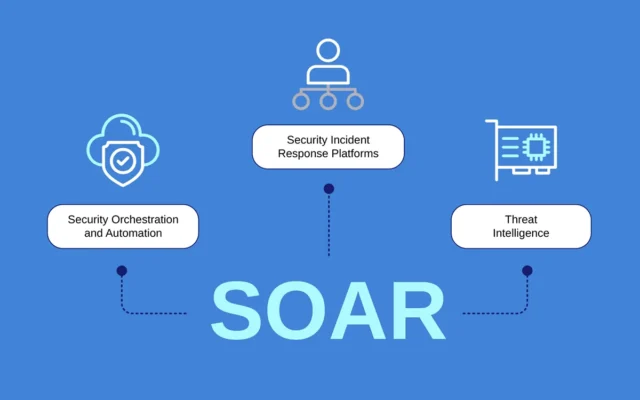
To overcome alert fatigue and its challenges, many organizations have turned to Security Orchestration, Automation, and Response (SOAR). While the automation portion handles repetitive tasks, the security orchestration aspect acts as the connective tissue that brings together disparate security systems into a single cohesive defensive environment.

Security Orchestration Defined

Source: visme.co

The automation tools within a SOAR platform automatically execute individual programmatic actions for tasks like blocking an IP address. Security orchestration is different. It focuses on integration and workflow management across an organization’s entire security stack.

DarkOwl, a leader in SOAR integration, explains that security orchestration connects disparate security tools. It brings together threat intelligence platforms, EDRs, SIEMs, and even ticketing systems to create a standardized execution pathway known as a playbook. Theoretically, an organization builds as many playbooks as it needs to maintain proper cyber defenses.

Why Security Orchestration Matters

Security orchestration matters because without it, disparate tools and systems are incapable of working together for maximum advantage. Tools and systems operate in silos, limiting their ability to improve an organization’s security posture. On the other hand, security orchestration accomplishes some very important things:

  • Silo Elimination – Orchestration makes it possible for disparate tools to exchange data seamlessly with no need for human intervention. Silos all but disappear.
  • Response Standardization – Orchestration ensures that security analysts follow repeatable and pre-approved processes during every incident. Human errors are reduced.
  • Response Acceleration – Orchestration reduces Mean Time to Respond (MTTR) by automatically coordinating actions across multiple systems. Incident response times drop from hours to seconds.

Within the context of SOAR integration, orchestration is very similar to a musical orchestra’s conductor. It brings all the players and instruments together, on the same page, so they produce cohesive music instead of a cacophony of noise.

Integrating SOAR With Existing Defenses Is Critical

Source: office1.com

Implementing SOAR integration allows security teams to optimize their existing technology investments. There is less need to replace what already exists because disparate tools work more effectively together. SOAR integration yields very tangible results.

For starters, integration connects external intelligence sources with a SOAR platform. This allows enterprise security tools to ingest massive amounts of high-value threat data automatically. When dark web intelligence identifies a potential threat, the platform can immediately trigger a defensive playbook.

SOAR integration also streamlines analyst workflows. In so doing, it reduces mental fatigue and human error. A good SOAR platform aggregates incident context within a central interface, allowing analysts to approve automated mitigation steps with a single click.

The icing on the cake is the ability for SOAR integration to scale with security operations. Unlike manual security procedures, which often cannot keep pace with growth, orchestrating security workflows within a SOAR environment scales things effortlessly. SOC teams can continue to process higher alert volumes without the need to hire more people.

Building Effective Security Orchestration Playbooks

Successful security orchestration depends on how well organizations structure their response playbooks. Each playbook should address a specific incident type and establish clear steps for investigation, escalation, and remediation. Many teams benchmark their own procedures against standardized references like CISA’s Cybersecurity Incident and Vulnerability Response Playbooks, which lay out a repeatable structure for identifying, coordinating, and remediating threats.

Consider a phishing incident. A playbook can automatically retrieve suspicious email headers, analyze embedded links, compare findings against threat intelligence databases, and identify other employees who received similar messages. Security analysts receive the collected evidence without manually switching between multiple platforms.

Organizations should prioritize frequently occurring incidents when developing their first playbooks. Starting with established procedures allows teams to evaluate performance, identify weaknesses, and refine automated workflows before expanding orchestration into more complex security scenarios.

The Importance of Reliable Security Integrations

Connecting security products doesn’t automatically guarantee that information flows correctly between them. Different systems may use incompatible data formats, authentication methods, or application programming interfaces (APIs). Poorly configured integrations can introduce delays and undermine the benefits of orchestration.

Security teams should therefore test integrations under realistic operating conditions. An endpoint that becomes unavailable, an expired authentication token, or an interrupted API connection shouldn’t cause an entire incident response workflow to fail without notification.

Maintaining detailed execution logs also helps analysts identify unsuccessful actions and investigate unexpected outcomes. Regular integration reviews become particularly important when organizations update existing security products or introduce new tools into their infrastructure.

Balancing Automated Responses With Human Oversight

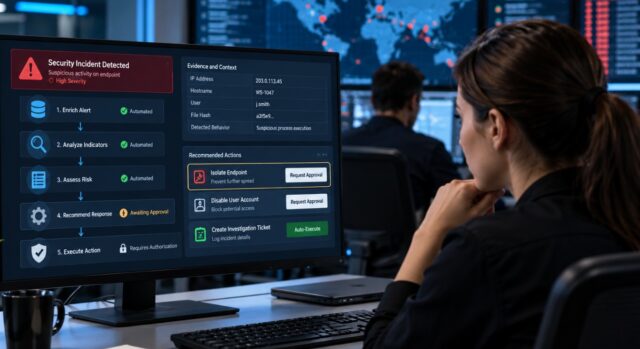
Not every security incident should trigger an entirely automated response. Certain actions, including isolating critical servers or disabling employee accounts, can interrupt business operations when executed incorrectly.

Security orchestration allows organizations to establish approval requirements for potentially disruptive actions. A playbook can gather evidence, assess indicators of compromise, and recommend a response while leaving the final authorization to an experienced analyst.

Lower-risk activities, such as enriching alerts and creating investigation tickets, can proceed without approval. Higher-impact decisions receive additional scrutiny. Establishing these boundaries helps organizations benefit from faster security operations without sacrificing accountability or introducing unnecessary operational risks.

Measuring the Impact on SOC Performance

Organizations need measurable evidence that their orchestration investments are improving security operations. Tracking performance before and after implementation provides a clearer picture than simply counting how many automated workflows have been deployed.

Mean Time to Detect (MTTD) and Mean Time to Respond (MTTR) are useful starting points, and frameworks such as NIST’s incident response guidance under CSF 2.0 offer a structured way to define and track them consistently. Security teams can also measure alert investigation times, false-positive rates, and the number of incidents requiring manual intervention.

However, faster responses shouldn’t come at the expense of investigation accuracy. Reviewing unsuccessful playbook executions and analyst feedback helps identify areas requiring improvement. Regular performance assessments allow SOC managers to adjust workflows as threats evolve and operational requirements change.

Security Orchestration Changes the Defensive Posture

SOAR platform integration relies on security orchestration to bring together fragmented operations. Orchestration creates an agile, intelligence-led defense that performs so much better than traditional siloed operations.

When all is said and done, security orchestration actually changes an organization’s defensive posture. Rather than constantly scrambling to make sense of things when incidents occur, orchestration invites security teams to be more proactive, less likely to chase noise, and better prepared to respond quickly when something happens.

And that is why optimizing SOC efficiency with security orchestration matters.

Discreet Protection for High-Net-Worth Families: Security That Fits Daily Life

For a high-net-worth family, security has to solve an awkward problem: it must be strong enough to matter and quiet enough not to dominate the day.

That rules out the fantasy that protection is simply a matter of adding more guards, taller gates, and more cameras. A family can have all three and still expose a travel itinerary through a shared calendar, leave a former vendor with unnecessary access, or let a compromised email account become the first step toward a physical problem.

The right goal is not maximum visibility. It is minimum unnecessary exposure. A discreet security program connects residential protection, personal safety, digital hygiene, staff procedures, privacy, and travel planning around the way the family actually lives.

Two suited professionals walking beside a luxury car, suggesting discreet executive protection in daily life.
Effective close protection should support movement and routine rather than announce itself.

Security starts with the family’s real routine

A useful assessment begins with ordinary questions. Who arrives at the principal residence each day? Which homes are occupied seasonally? Who knows when the family travels? Which assistants can approve payments or access documents? Where do children spend time? Which family members are publicly visible, and which are vulnerable to fraud or impersonation?

These questions are more revealing than a generic checklist because risk often sits between systems. A driver may know the weekly schedule. A contractor may know a secondary entrance. A social post may confirm that a property is empty. A personal phone may hold the same itinerary that the family office protects carefully on its own network.

Red5 Security’s family-office model makes the useful point that physical, digital, privacy, travel, and reputational concerns cannot be treated as isolated problems. My view is that this is the central design principle: protection should follow the family’s relationships and routines, not the boundaries of individual suppliers.

The home should feel normal, not fortified

Residential security is usually strongest when it is layered and calm. Access control, lighting, alarms, monitored cameras, visitor procedures, secure delivery handling, and a clear response plan can work together without making a home feel like a checkpoint.

The best design also looks beyond the front gate. Staff entrances, garages, service lifts, landscaping work, household deliveries, and temporary contractors all create different access conditions. The family does not need to treat everyone as suspicious; it does need to know what access each person requires, for how long, and how that access ends.

Close-up of a door lock and keys, illustrating controlled access and household security.
Controlled access is less about inconvenience than about knowing who can enter, when, and why.

A residential review should therefore examine:

  • How visitors, deliveries, contractors, and household staff enter and move through the property.
  • Whether alarms and cameras cover the places an intruder or insider would actually use.
  • How keys, codes, vehicle access, and smart-home permissions are issued and withdrawn.
  • Whether the household knows what to do during a suspicious approach, medical emergency, fire, or forced-entry concern.
  • How the property’s public and digital footprint could reveal ownership, occupancy, routines, or vulnerabilities.

Technology is helpful, but it is not automatically protective. A 2026 CISA advisory on smart-home equipment described vulnerabilities that could expose sensitive information or allow unauthorized device control, and recommended minimizing internet exposure and isolating control devices behind firewalls. The lesson is simple: connected locks, cameras, and home-management systems belong in a managed network, not on an unexamined collection of default settings.

Privacy is a physical-security measure

Privacy work can sound administrative until its consequences become physical. Public property records, data-broker listings, family relationships, school affiliations, aircraft information, social media posts, and leaked credentials can be combined to reveal where people live, when they are away, and who is likely to help them.

The UK National Cyber Security Centre’s 2025 principles for protecting sensitive personal information specifically identify high-net-worth status as a factor that can increase the potential harm from misuse of personal data. That guidance also stresses stronger protection against insider threats, not only external cyberattacks.

For a family, the practical response is not to disappear from public life. It is to decide which information must be public, which should be restricted, and which should never be casually shared. That may mean reviewing data-broker exposure, separating personal and household-office accounts, tightening social-media settings, and agreeing on what assistants and vendors may disclose.

Digital security belongs in the household briefing

A family’s digital security should be understandable enough for everyone to follow, including teenagers, older relatives, guests, and temporary staff. Sophisticated tools do not compensate for an unclear rule about payment approvals or a family member who shares live location details publicly.

The NCSC’s guidance for high-risk individuals recommends unique passwords, two-step verification, prompt software updates, care with social-media disclosures, and reporting suspicious messages even after someone has clicked. Those are basic measures, but they matter because an attacker often starts with the least managed account, not the most valuable one.

For higher-risk households, the program may also include separate devices for sensitive financial work, managed accounts, encrypted channels for confidential information, secure backups, phishing exercises, and a tested process for lost devices. The point is not to make the family office technically elaborate. It is to remove ambiguity at the moments when people are rushed.

Two security cameras mounted on a minimalist exterior wall, illustrating unobtrusive monitoring.
Monitoring works best when it covers meaningful exposure points without overwhelming the property.

Travel protection should be adjustable

Travel changes the security picture because familiar controls disappear. A family may be moving through airports, hotels, events, private residences, and unfamiliar roads while schedules change quickly and information is shared among several providers.

That does not mean every trip requires a visible protection detail. A proportionate plan might include destination research, advance work at venues, secure transportation, protected itinerary handling, check-in procedures, medical contingencies, or close protection only for a particular meeting or movement. A holiday and a contentious public appearance should not receive the same template.

The family office should know who can see the itinerary, how last-minute changes are authenticated, what happens if a traveler misses a check-in, and who has authority to alter the plan. This is where discretion becomes operational: fewer people need the full picture, but the right people need it early enough to act.

Staff trust needs structure

Household employees, drivers, tutors, property managers, chefs, contractors, and advisers are essential to daily life. Treating them as a threat damages the culture that makes a household work. Treating access as an informal privilege creates avoidable exposure.

Good governance is quieter than suspicion. It uses appropriate vetting, references, confidentiality expectations, role-based access, visitor rules, clean departure procedures, and periodic reviews. A departing employee should not retain a key, device, building code, shared password, or calendar permission simply because nobody remembered to remove it.

The same principle applies to vendors. Before granting access, ask what the supplier needs to do the job, what information it will retain, who else can reach that information, and how access will be revoked. A single risk owner in the family office can prevent these questions from being lost between the household manager, IT provider, security installer, and executive assistant.

A discreet program is still a serious program

Discretion does not mean passive security. It means matching the intervention to the actual risk.

A family might need a focused residential assessment after buying a new property, a travel plan for a particular region, digital-exposure work after a public dispute, or a standing advisory relationship because the family’s visibility changes constantly. It might not need permanent visible protection at every residence.

I would be wary of any provider that begins with a package rather than a risk conversation. The useful sequence is assessment, priorities, ownership, implementation, and review. The answer may include personnel and equipment, but it may also be better passwords, fewer exposed records, clearer staff permissions, or a rehearsed response plan.

Five questions to ask before adding more security

Does the measure protect a real vulnerability?

Identify the exposure first. A camera pointed at an already secure wall may be less valuable than controlled access at a service entrance.

Will the family actually use it?

A complicated process that everyone bypasses is weaker than a simpler rule that survives busy days, travel, and family disagreement.

Who owns the decision?

Someone should be accountable for the risk register, vendor coordination, incident contacts, and review schedule. Shared responsibility without a named owner creates gaps.

What happens when circumstances change?

New staff, a new residence, a public event, a dispute, a major trip, or a child reaching a new stage of independence can change the risk profile. Security should be revisited after those events, not only on an annual calendar.

Can the household respond under pressure?

Plans should be short enough to use and practiced enough to remember. A tabletop exercise or briefing can reveal confusion long before an incident does.

The quiet advantage

The strongest protection for a high-net-worth family is rarely the most dramatic object on the property. It is the connection between small decisions: who receives an itinerary, which device approves a payment, whether a contractor is escorted, how a lost phone is disabled, and who calls whom when something feels wrong.

That is security that fits daily life. It preserves spontaneity where the risk allows it, adds friction where it matters, and gives the family a clear way to respond when normal routines stop being reliable.

The Cost of Litigation: Why Large Legal Cases Are So Expensive

Wooden gavel on a table beside case folders in a courtroom, symbolizing expensive litigation

Litigation is expensive, and large litigation is expensive in a way that surprises even the people paying the bill. A commercial dispute that looks manageable when it is filed can run for years and end with total costs that rival the amount in controversy. The reasons are structural rather than mysterious: a lawsuit is a process that generates work-documents to collect, witnesses to depose, experts to retain, motions to brief-and each of those tasks has to be paid for before anyone knows how the case will end.

This article explains what drives the cost of major legal cases, how those costs are shared, and why a reliable final number is so hard to produce. The focus is on how the system works, drawing on court data, empirical research, and professional fee surveys.

What “the cost of litigation” actually includes

Lawyer in a business suit reviewing legal documents at her office desk

Litigation spending is usually grouped into three buckets. Professional fees pay for lawyers, paralegals, and other timekeepers, generally recorded in small increments-often six minutes-and billed at hourly rates that rise with seniority and market. Hard costs, or disbursements, are payments to third parties: court reporters and transcripts, filing and service fees, translation, travel, and expert witnesses. Litigation support covers the technology and labor behind discovery, including collecting, processing, hosting, and reviewing documents.

In document-heavy matters, the third bucket can grow large enough to rival or exceed the first. One reason is that electronic information now exists in volumes that dwarf the paper files of earlier decades: email, chat messages, shared drives, and backups all become potential evidence. The cost is not mainly storage-storage itself is cheap-but the human judgment required to decide what is relevant and what is protected by privilege.

The amount at stake is the strongest single predictor

Lawyers in a modern office discussing legal strategy during a consultation

If one variable best explains why one case costs far more than another, it is the amount in controversy. Higher stakes justify larger legal teams, broader discovery, more experts, and longer preparation. The American Intellectual Property Law Association (AIPLA) publishes median costs for patent litigation by amount at risk, and the pattern is consistent across its survey series. The figures below are medians from the 2023 edition, covering 2022 data, and represent cost per patent.

Amount at risk Through discovery and claim construction Through trial and appeal
Under $1 million $300,000 $600,000
$1 million–$10 million $600,000 $1,000,000
$10 million–$25 million $1,500,000 $3,000,000
Over $25 million $1,500,000 $3,625,000

Source: AIPLA Report of the Economic Survey 2023 (2022 data), median total cost per patent, all varieties. Figures are medians and will vary by technology, venue, and firm; confirm against the current edition before relying on a specific number for budgeting.

Notice that the jump from the smallest to the largest category is not gradual. Moving from a case worth under $1 million to one worth more than $25 million multiplies the median cost several times over through trial. That is partly a matter of resources: a party with tens of millions at risk can rationally spend more to protect it. It is also a matter of complexity-larger cases tend to involve more parties, more documents, more disputed issues, and more expert testimony.

The same relationship shows up outside intellectual property. Empirical work published in the Duke Law Journal, drawing on Federal Judicial Center research, found that the monetary stakes in a case were the single best predictor of its total cost, and that a 1 percent increase in stakes was associated with roughly a 0.25 percent increase in cost. That finding cuts against the idea that any one phase, or any one participant, single-handedly explains why cases are expensive.

Why discovery is where large cases get expensive

Hourglass beside banknotes illustrating billable hours and the rising cost of legal cases

Discovery is the pretrial exchange of information, and it is routinely the most expensive phase of a large case. Both sides must identify relevant material, preserve it, review it, and produce what the rules require-while withholding what is privileged. Because that work scales with the volume of data, a matter involving millions of documents can generate costs that grow faster than the rest of the case.

A widely cited study from the RAND Institute for Civil Justice examined 57 large-volume electronic discovery productions at eight major companies. In those cases, the authors found that review-people reading documents to assess relevance and privilege-typically consumed about 73 percent of e-discovery production costs, while processing consumed about 19 percent and collection about 8 percent.

E-discovery task Share of production cost
Review (relevance and privilege) About 73%
Processing About 19%
Collection About 8%

Source: RAND Institute for Civil Justice, “Where the Money Goes” (2012), 57 large-volume e-discovery productions. The authors caution that the results describe very large companies and cannot be generalized to all litigants.

Two qualifications keep this in perspective. First, review is labor-intensive because it requires human judgment about privilege and relevance, and mistakes can be costly; the same study noted limited room to speed up human review without sacrificing accuracy. Second, discovery is not always the dominant cost. Research summarized in the Duke Law Journal found that, in ordinary federal cases, discovery typically accounts for somewhere between 20 and 50 percent of total litigation costs, with wide variation-not the 70 percent or more that surveys of attorneys sometimes report. In the most document-heavy matters, the higher estimates can hold; in routine cases, they generally do not.

Federal rules give courts tools to keep discovery in proportion to what is at stake. Rule 26(b)(1) limits discovery to material that is relevant and “proportional to the needs of the case,” weighing the amount in controversy, the parties’ resources, and whether the burden or expense outweighs the likely benefit. A separate provision, Rule 26(b)(2)(B), allows a party to identify electronically stored information as not reasonably accessible because of undue burden or cost. Cost-shifting-requiring the requesting party to pay for some production-is generally considered only in narrower circumstances, and the framework courts still reference comes from a 2003 decision, Zubulake v. UBS Warburg, which set out factors such as how well tailored the request is and how the production cost compares to the amount in controversy.

There is a genuine debate about how well these limits work. Practitioners who favor broad discovery argue that proportionality rules, if applied too aggressively, can deprive a party of evidence it needs to prove its case-particularly when the relevant information is held almost entirely by the other side. The empirical record supports neither extreme: discovery costs are real and can be severe in large matters, but the evidence does not show that runaway discovery is typical of federal litigation as a whole.

Experts, depositions, and the multipliers that scale a case

Beyond discovery, several line items scale with ambition and complexity. Expert witnesses are a distinct category: they charge premium rates and are often less negotiable than attorney billing. SEAK’s 2024 Survey of Expert Witness Fees, based on responses from more than 1,600 experts, reported median hourly rates of about $450 for file review and case preparation and about $500 for deposition and trial testimony, with a median retainer of $3,000. Those are self-reported figures from a self-selected sample, so they are best read as an indication of structure and order of magnitude rather than an audited benchmark. High-demand specialties can charge considerably more.

Depositions generate their own costs. Each one involves attorney preparation, a court reporter, a transcript, and sometimes video, and each can take hours or days. A case with numerous witnesses on both sides can accumulate tens of thousands of dollars in deposition costs before trial. Expert involvement often multiplies the figure, because a complex matter may need several experts-one on technical questions, another on damages-and each expert must review documents, write a report, and prepare to be deposed.

Finally, the behavior of the other side and the court’s schedule are variables a party cannot fully control. Additional motions, discovery disputes, counterclaims, and delays all add work. Trial preparation tends to expand to fill the time available before trial, and each additional day of trial multiplies attorney time, transcript pages, and expert fees.

Who pays, and how the bill is structured

Calculator resting on US dollar bills representing budgeting for expensive legal fees

The fee arrangement determines when and how the money changes hands. Under hourly billing, the client generally pays as the case proceeds, regardless of outcome, and bears the disbursements. Under a contingency arrangement-common in personal injury and some other plaintiff-side matters-the attorney is paid a percentage of any recovery, often in the range of a third, with the exact figure set by the agreement and sometimes rising if the case goes to trial. Even then, the client is usually responsible for advancing or reimbursing hard costs.

The default rule in U.S. litigation is that each side pays its own attorney’s fees, but there are exceptions. Some statutes and contracts shift fees to the prevailing party. Separately, courts may award certain “taxable costs” to the winner, which generally cover items such as clerk and marshal fees, transcript fees, and witness fees-not attorney time or most litigation-support expenses. Insurance may cover defense or indemnity when a claim falls within a policy. And a settlement or judgment may reimburse expenses advanced during the case, depending on the fee agreement and any liens.

Third-party litigation funding has expanded the options available to parties that prefer to spread or transfer the risk of a case. In these arrangements, an outside investor typically provides capital to cover legal fees and expenses in exchange for a share of any recovery if the case succeeds. Market-research estimates of the size of this sector vary with methodology, but several place the global market somewhere in the range of roughly $20 billion to $30 billion as of 2025–2026, with continued growth projected. Because cross-border disputes can involve parties, counsel, and funders in several jurisdictions at once, trade publications that follow international litigation coverage often report on how these arrangements are structured and how different courts approach them.

Why the final number resists prediction

Classic law library with shelves of books, a gavel, and a Lady Justice figurine

A litigation budget is best understood as a written plan rather than a quote. It maps the expected work-pleadings, motions, discovery, depositions, expert reports, mediation, and possible trial-and prices it by task. Because opposing counsel, the court, and unforeseen events all influence what happens, no budget can be precise. The value of the exercise is alignment: it gives both the client and the legal team a baseline against which actual spending can be compared, and a trigger for revisiting strategy when the case shifts.

Most civil cases do not reach a verdict, which shapes the economics. According to the Administrative Office of the U.S. Courts, only about 0.5 percent of federal civil case terminations in the twelve months ending September 30, 2024, reached trial; the rest were resolved through settlement, dismissal, or other dispositions. That means the pivotal cost decision is often not “trial or no trial” but how much to spend on the pretrial phases that shape the settlement value.

Several practices are commonly used to keep the pretrial phases from expanding without limit. Early case assessment, phased budgets with decision points after major milestones, staffing routine work at appropriate levels, and technology-assisted review are all widely discussed. Each has limits-automated review still needs qualified oversight, and courts expect the process to be defensible. But together they reflect a practical reality: in litigation, cost is a series of decisions made over time rather than a single price set at the outset.

Questions people ask about litigation costs

Why do large legal cases cost so much more than small ones?

Mainly because the amount at stake drives the scale of the work. Larger disputes justify bigger teams, broader discovery, more experts, and longer preparation, and the cost differences compound across phases rather than staying proportional.

Is discovery always the most expensive part of a case?

No. In document-heavy commercial and patent matters, discovery can be the largest expense, and RAND’s research found that review alone consumed most of e-discovery production costs in the cases it studied. In ordinary federal cases, empirical research suggests discovery typically makes up roughly 20 to 50 percent of total litigation costs.

How much does a patent lawsuit cost?

It depends heavily on the amount at risk. AIPLA’s 2023 survey reported median costs per patent ranging from about $600,000 for cases under $1 million at risk to roughly $3.6 million for cases over $25 million at risk, through trial and appeal. These are medians, and individual cases vary widely.

Can the losing party be ordered to pay the winner’s legal fees?

Sometimes, but not by default. The general rule in U.S. litigation is that each side bears its own attorney’s fees. Fee-shifting applies where a statute or contract provides for it. Courts can also tax certain costs against the losing side, but those taxable costs are usually a small fraction of total spending.

How do contingency fees work?

The attorney receives a percentage of any recovery, typically around one-third, and nothing if the case is lost. The exact percentage is set by the agreement and may increase if the case goes to trial. Clients often remain responsible for hard costs such as filing fees and expert charges.

What is third-party litigation funding?

It is an arrangement in which an outside investor provides capital to cover some or all of a case’s legal costs in exchange for a share of any recovery. It is most common in commercial disputes, arbitration, and class actions, and it is regulated differently across jurisdictions.

The bottom line: cost is a set of decisions, not a single rate

Large legal cases are expensive because they are long, document-intensive, and uncertain, and because the work required to prepare and try them is performed by people whose time is billed. The headline hourly rate matters, but it is only one input. The bigger drivers are how much is at stake, how much information has to be reviewed, how many experts are needed, and how far a case travels before it resolves.

For anyone trying to plan around a major dispute, the most useful step is not to predict the final number but to understand its components and the points at which spending can be revisited. A case that looks expensive on paper is often one where cost discipline was never mapped to the phases that actually generate the bill-and where the decision to keep going was never re-examined along the way.


5 SEO Myths About Backlinks Everyone Should Stop Believing

Vintage typewriter printing the word Backlinks, illustrating backlink SEO concepts

Search for advice on backlinks and you will drown in it. Vendors sell them by the thousand, tools score them on a dozen different scales, and a lot of the guides still read like they were written in 2013. The reason so much of it contradicts itself is that most of it rests on five assumptions that either expired years ago or were never true in the first place.

Here is where I land before we start: backlinks still matter, but not as a number you accumulate. They work as evidence of reputation, and the system doing the judging has gotten much better at telling a real endorsement apart from a bought one. Every myth below is a version of missing that distinction.

Wooden blocks spelling SEO on a laptop keyboard representing search optimization

If you only have one screen’s worth of attention, the table below is the honest summary. Everything under it is the reasoning, because the reasoning is where the money is actually saved.

Myth What the evidence actually shows What to do instead
More backlinks equal higher rankings Correlation, not causation. Unique referring domains track rankings more closely than raw link count. Chase relevance and one strong link over ten weak ones.
Nofollow links are worthless Google has treated nofollow as a hint since 2019, and AI search engines ignore the attribute entirely. Accept nofollow links from good sources. Stop pricing them at zero.
Domain Authority is Google’s metric DA and DR are third-party scores. Google uses neither. Use them as rough guides, never as targets.
You must disavow every toxic link Google ignores most spam automatically, and “toxic” is not a Google concept. Leave it alone unless you have a manual action to clear.
Buying links always triggers a penalty The rules target manipulation and non-disclosure, not the transaction itself. Vet relevance, and make sure any paid placement is properly qualified.

Sources for the table: Google’s published spam policies and link-attribute guidance, Backlinko’s 11.8 million-result ranking study, and Ahrefs’ 75,000-brand visibility study. Dates and links are in the text and the methodology note below.

Sources for the table: Google’s published spam policies and link-attribute guidance, Backlinko’s 11.8 million-result ranking study, and Ahrefs’ 75,000-brand visibility study. Dates and links are in the text and the methodology note below.

Myth 1: More backlinks mean higher rankings

The most stubborn backlink myth is also the easiest to dismantle. Backlinko’s study of 11.8 million Google results found that the number-one result has, on average, 3.8 times more backlinks than the results ranked two through ten. Vendors quote that line constantly. They leave out the part that makes it interesting.

That study, and every other large one like it, measures correlation. Pages rank because they are genuinely useful, and useful pages tend to attract links. The link count is a symptom of being worth linking to, not the cause of the ranking. Read the same dataset another way and the messiness shows: roughly 95 percent of all pages have zero backlinks, and the number of unique referring domains correlates more strongly than the total count. Ten links from ten different sites beat ten links from one site with a footer widget.

If a report leads with total backlinks, I close it. Sort by referring domains or do not bother. The count is the least interesting number in any backlink tool.

Hand pointing at colorful business charts and graphs on a wooden desk

Myth 2: Nofollow links are worthless

This one was true until September 10, 2019, which is presumably why it refuses to die. That is when Google announced it was treating nofollow, sponsored, and ugc as hints rather than hard directives. Google can now choose to use a nofollowed link for crawling, indexing, or ranking if its systems decide the link is a genuine signal.

In practice, it does not promise to count any particular nofollow link, so you should never build a strategy that depends on it. But “worthless” is still the wrong word. A nofollow mention on a site your buyers actually read sends referral traffic, reinforces your brand as an entity, and often sits on a page that later earns you a followed link anyway. A profile that is 100 percent dofollow is a red flag, not an achievement.

And in AI search, the attribute stops mattering almost entirely. Chatbots and AI Overviews retrieve and cite pages on relevance and reputation, not on the HTML of a link tag. Some of the most frequently cited sources across those systems, like community forums and encyclopedia pages, are nofollow by default. Call those links zero and you are arguing with the citation data.

Laptop displaying Google Analytics dashboard in a modern workspace

Myth 3: Domain Authority is the number Google uses

Domain Authority from Moz and Domain Rating from Ahrefs are useful estimates built by companies that are not Google. Google does not use either one. This matters because teams routinely set “get to DR 60” as a goal, then optimize for a metric that exists only on a scoreboard they invented.

My rule of thumb is blunt: a link from a domain rating 30 site that is dead-on your topic is worth more than a link from a rating 80 site that has nothing to do with you. Relevance multiplies the value of a link; authority without relevance mostly adds a nice-looking number to a spreadsheet. Use these scores to compare candidates that are otherwise similar, then stop.

Here is the part that stings: chasing authority is how sites end up with links from general news outlets and coupon directories while their actual niche peers never mention them once.

Myth 4: You should disavow every sketchy link

Backlink audit tools are happy to label links “toxic.” Google has no such concept. In March 2026, Google’s John Mueller answered a question on Bluesky about whether disavowing was worth it and said, “Most sites don’t need it, but that’s not all sites.” He has spent years making the same point: if a random tool can flag a bad link, Google’s own systems can almost certainly ignore it without your help.

The disavow file exists for specific situations. You have a manual action for unnatural links, or you personally built or bought links that violate the guidelines and you want them gone. For the everyday site with a normal mix of links, though, the disavow ritual is closer to anxiety management than SEO. (Yes, I have watched people disavow a legitimate industry magazine because its rating looked low. It does not end well.)

Unless you are in one of those two situations, leave your bad links alone. You have better uses for the afternoon.

Myth 5: Buying backlinks always gets you penalized

The rule is narrower than the folklore suggests, and getting it right is where a lot of businesses either burn money or leave growth on the table. Google’s spam policies prohibit links created “primarily for the purpose of manipulating search rankings,” and they explicitly call out buying or selling links that pass ranking credit without being disclosed. The violation is the manipulation and the lack of disclosure, not the fact that money changed hands.

Google says as much itself: buying and selling links is a normal part of the web economy, and it is not a violation as long as the links are qualified with a rel=”sponsored” or rel=”nofollow” attribute. So the honest test is not “paid versus free.” It is whether the placement would exist on its merits and whether the commercial relationship is disclosed.

That test also tells you how to judge anyone offering backlinks for SEO. Ask which sites, ask who decides placement, and ask how links are qualified. A provider that answers those three questions clearly is working with the rules. One that promises “guaranteed followed links on DR 50-plus domains, no disclosure needed” is selling you a future cleanup job.

One more thing worth internalizing, because it changes how you spend: across 75,000 brands, Ahrefs found that unlinked brand mentions correlated with AI Overview visibility at 0.664, against 0.218 for backlinks. A link is one form of being vouched for. In AI search, being named at all is now the stronger signal. That does not make backlinks pointless for classic Google rankings, which still run on them, but it does mean the company you keep matters more than the connections you buy.

Frequently asked questions

Are backlinks still a ranking factor?
Yes. Google’s own documentation lists links as a core signal, and large correlation studies keep showing that pages with stronger link profiles rank higher. What has changed is that quality and relevance now do most of the work, and the raw count matters far less than it once did.
Do nofollow links help SEO at all?
Indirectly, and sometimes directly. Since 2019 they are hints, not directives, so Google may count a good one. They always bring referral traffic and brand reinforcement, and AI engines do not look at the attribute at all.
Is Domain Authority what Google ranks by?
No. Domain Authority and Domain Rating are third-party estimates from Moz and Ahrefs. Google does not use either metric. Treat them as rough comparison tools, not as scores to grind upward.
Should I disavow bad backlinks?
Only if you have a manual action for unnatural links, or you know you built links that break the guidelines. For most sites, Google handles spam automatically, and a hand-built disavow file is more likely to remove something useful than to fix a problem.
How many backlinks do I need to rank?
There is no number. The useful question is how many credible, relevant sites in your field genuinely reference you. One link from a trusted niche publication can outperform hundreds from directories and low-quality guest posts.
Can you rank without any backlinks?
Yes, for lower-competition and long-tail queries, especially if your site has clear topical coverage and clean structure. For competitive commercial keywords, a strong link profile is usually the difference between ranking and hoping.

Your Truck Breaks Down Far From Home: What to Do in the First 30 Minutes

Blue semi truck traveling alone on a rural highway under a clear blue sky, far from home

There is a particular silence after your truck quits 300 miles from home. The engine dies, the dash lights up, and for a few seconds you just sit there listening to the wind come off the interstate. What you do in the next ten minutes matters more than anything you do in the next ten hours.

Most breakdown advice is fine as far as it goes. Pull over, turn on your hazards, call somebody. The part that gets skipped is the part that keeps you alive, and the part that keeps a bad afternoon from becoming a citation or a claim. Here is the order I would actually work it, whether you are driving a pickup with a boat on the trailer or an 80,000-pound tractor-trailer.

Worried driver speaking on the phone while leaning on a broken down vehicle with the hood open

Get the truck off the traveled lane, then get visible

Not as soon as it is convenient. Now. If the engine is still turning over and the steering works, use whatever momentum is left to roll onto the widest, straightest shoulder you can reach, or the next exit ramp. A ramp shoulder almost always beats a bridge shoulder.

The moment you stop, activate your hazard flashers. That is not a suggestion. The federal rule at 49 CFR 392.22 requires flashers immediately whenever a commercial vehicle is stopped on the traveled portion or shoulder of a highway, and they stay on until your warning devices are out. Then set the parking brake, keep your wheels straight, and take one breath before you touch the door handle.

Warning-device placement trips up drivers because it is not one distance, it is several. Under the same regulation, the devices go out within 10 minutes, at roughly 10 feet, 100 feet, and 100 feet, with the third one pointing back the other way on a two-way road. On a divided or one-way highway, the two rear devices move out to 100 and 200 feet. If you are within 500 feet of a curve, a hill crest, or anything else that hides you, one device goes 100 to 500 feet back toward the obstruction.

Before you step out, put on a high-visibility vest. Stand on the side away from traffic, and never between the tractor and the trailer. The vest is the cheapest insurance you own.

Stay in the cab with your seatbelt on unless there is fire, smoke, or a fuel leak. If any of those three are present, get well clear of the truck and call 911 from a distance.

Now work the phones: 911, dispatch, or roadside?

The order depends on whether people are in danger right now. A smoking engine block and a truck that swallowed a steer tire are the same mechanical problem and two totally different calls.

Situation when you stop Call first Why
Fire, smoke, fuel or hazmat leak, injury, or you are blocking a live lane 911 Life-safety events, not repair calls. A blocked lane becomes a secondary crash scene fast.
No immediate danger, but the truck cannot move and no one is en route Heavy-duty tow or roadside provider A tow relocates the problem to a shop with a bay, parts, and lights instead of a shoulder.
A minor, known issue (dead battery, flat, out of fuel) on a wide, safe shoulder Mobile mechanic or fuel service Most of these are fixed in place, usually faster and cheaper than a tow.
You drive for a carrier or are under a broker’s load Dispatch or safety, before anyone else They authorize the vendor, protect the load, and often have a preferred shop.

The 911 triggers follow FMCSA roadside guidance; the warning-device timing and placement above come from 49 CFR 392.22 (checked September 2026).

The 911 triggers follow FMCSA roadside guidance; the warning-device timing and placement above come from 49 CFR 392.22 (checked September 2026).

Truck driver standing outside his truck talking on the phone to call for roadside assistance

For anything that is not an emergency, the person you call first is usually whoever controls the repair money. If you drive for a carrier, that is dispatch. If you are an owner-operator or a private truck owner far from your own shop, that is you, and the call is to a service provider you may have never heard of.

Whoever answers, the call goes faster if you have five things ready: exact location with mile marker and direction; tractor and trailer unit numbers, or your plate; the symptom in plain words (“no crank,” “air loss,” “steer tire blowout”); what the load is and whether it is temperature-controlled; and a callback number that will stay reachable. A GPS pin from your phone is worth more than a street name out in the country.

Finding a shop that will actually roll a truck to you is its own problem when you are nowhere near your usual contacts. A directory that lists vetted truck repair and roadside assistance providers by location can turn an hour of phone tag into a few minutes, which is exactly what you want when you are standing on a shoulder at 2 a.m. in weather.

The shoulder is the most dangerous place most drivers ever park

Here is the number that changed how I think about waiting it out. The AAA Foundation’s 2024 analysis of roadside assistance provider fatalities identified 123 tow and service workers killed while working at the roadside between 2015 and 2021. About 85 percent of those deaths happened on high-speed, limited-access highways, and in roughly 60 percent of the incidents the striking vehicle left the roadway and hit the person on the shoulder or roadside. The person did nothing wrong. The shoulder simply offered no protection from a driver who fell asleep, looked at a phone, or ran off the pavement.

The same risk applies to you standing behind your own truck. Safety researchers and the Insurance Institute for Highway Safety estimate that at least several hundred people a year die in crashes linked to someone leaving, working on, or returning to a stopped vehicle. Night makes it worse. So does a narrow shoulder, a blind curve, and any time you crouch down behind the box where oncoming traffic cannot see you at all.

All 50 states also have Move Over or Slow Down laws, and they are getting broader. A 2024 Government Accountability Office review found 21 states cover disabled vehicles specifically, and NHTSA counts 19 states plus Washington, DC that apply the rule to any vehicle sitting with hazard lights or warning lights on. That helps you a little. It does not make the shoulder safe. I treat it as the last resort, never as a repair bay.

The hours-of-service myth that could hand you a violation

You will hear, from drivers and from plenty of blogs, that a breakdown lets you drive two extra hours to reach safety. I would not build a plan on that reading, because the rule does not say what people think it says.

The two-hour extension lives in the adverse driving conditions exception in 49 CFR 395.1, and adverse conditions are defined there as snow, ice, sleet, fog, and unusual road or traffic conditions. A failed water pump is not weather. FMCSA’s own published guidance is blunter still: the emergency exception is not meant to cover mechanical failures, any more than it covers a driver wanting to get home or a shipper demanding an earlier delivery.

What is genuinely true is less exciting and more useful. While you wait for repair, you are on-duty not driving, and that time counts against your 14-hour window and your 60- or 70-hour total. If the fix runs long, you may need a full 10-hour reset before you turn a wheel. Annotate the breakdown on your ELD with the time, location, and what happened, so the gap in your log has a documented explanation.

My read: the smart move is to assume the clock keeps running, then be pleasantly surprised if a shop gets you moving inside it. Planning around a loophole that probably will not hold up is how a mechanical breakdown becomes a compliance problem on top of a repair bill.

Far from home changes the math

Mechanic inspecting a truck engine in a dimly lit garage during a roadside repair

A breakdown at the end of your street is an inconvenience. The same breakdown in a state where you know no one is a logistics problem, and a financial one. Repair and maintenance costs have climbed faster than most other trucking line items in recent years, and the emergency variety carries a premium on top of that. Meanwhile the truck is earning nothing, and its fixed cost keeps ticking: ATRI’s operational cost research put the average cost of running a truck at $2.260 per mile in 2024, and its 2026 update reported that the average distance between breakdowns fell to 36,891 miles, down about 3.6 percent from the year before. Fewer miles between failures means more roadside calls across the fleet, and a thinner cushion when it is your turn.

So before the tow hooks up, decide three things:

  • Where it gets fixed. A mobile tech on the shoulder handles batteries, tires, fuel, air leaks, and small electrical faults. Anything needing a bay, a lift, or parts on order means a tow, and you should confirm out loud who chooses the destination shop before the driver pulls away.
  • How you get home, or whether you do. A same-day fix is one plan; a two-day parts wait is another. If the repair runs overnight, a hotel and a shower beat a night in a sleeper in a strange town, and most policies reimburse approved lodging.
  • What paperwork you keep. Photograph the truck’s position, the dash, any damage or leak, and the units and plates. Save every tow bill, parts receipt, and work-order number. Documentation is what gets you paid back and settles billing disputes later.

Tow truck operator loading a broken down vehicle onto a flatbed for transport

One caution on the tow itself: ask for an itemized estimate before dispatch, confirm where the mileage clock starts, and find out whether after-hours or storage fees apply. The dispatch fee, the labor rate, the mileage, and any equipment charges are separate line items, and they can add up fast when you are the one paying.

Where to wait, and how to wait well

Brightly lit truck stop and gas station at night with parked trucks, a safe place to wait during a breakdown

If the shoulder is dangerous and the truck will sit for hours, getting yourself to a lit, populated place is often the right call, especially after dark and especially after a rainstorm. A truck stop, a 24-hour service station, or a motel lobby where staff can see you is a better wait than a dark cab on a blind stretch. Lock the truck, take your phone, charger, keys, and wallet, and tell dispatch and a family member exactly where you are going.

Do not walk off down the highway looking for help. On a remote stretch in bad weather, the truck is easier for rescuers to find than you are, and the distance to the next exit is almost always longer than it looks. If your emergency kit includes a satellite messenger or you still carry a CB, this is the moment they earn their space in the cab.

What not to do

  • Do not stand between the tractor and the trailer, or anywhere on the traffic side. It is the single most common way roadside workers die.
  • Do not crawl under a truck on a live-lane shoulder, and do not open an air system to hunt a leak there. That work belongs in a bay.
  • Do not “test drive” a sick truck to see if the fault clears. You can turn a repair into a rebuild, or into a crash.
  • Do not leave the scene before the police, the tow operator, or a dispatcher tells you it is fine, and do not let anyone open your trailer without authorization.
  • Do not discuss your exact breakdown location with strangers who happen to stop. Be polite, stay in the cab with the window barely down, and say help is already on the way.

Questions drivers ask at the roadside

Can I just fix it myself on the shoulder?

Only the simple, safe things: add coolant, swap a fuse, air up a tire, jump a battery, add fuel. Anything that involves going under the truck, working on air brakes, or a job you have never done before waits for a technician.

How long can I legally leave a broken-down truck on the shoulder?

There is no single federal time limit, and practice varies by state. Interstates and highways treat shoulders as emergency space, not parking, so an extended stay can draw a ticket or an involuntary tow. If the repair will take more than a few hours, plan a tow to a shop or a safe lot.

Does a breakdown extend my hours of service?

Not as a mechanical failure. FMCSA’s adverse driving conditions exception covers weather and road or traffic conditions, and the agency’s guidance says the emergency exception does not include mechanical failures. Waiting time is on-duty not driving and counts against your 14-hour window.

What if I break down with no cell signal?

Stay with the truck, deploy your warning devices, and use a CB radio, satellite messenger, or emergency beacon if you carry one. Use highway markers and landmarks to describe your location when you do get a signal, and do not walk for help in extreme heat, cold, or darkness.

Should I stay with the truck the whole time?

Yes, unless there is fire, a fuel or hazmat leak, or the area feels unsafe. The truck is your best shelter, it is what rescuers are looking for, and it protects your cargo. Get yourself to a safe, lit place only when staying puts you in more danger than leaving.

What information speeds up the repair?

The five essentials: exact location with direction and mile marker, unit and trailer numbers or plates, the symptom in plain language, the load type and temperature requirements, and a phone number that will stay reachable. Add photos of the dash and any visible damage.